
EV Charger Installation in Sacramento
A charger where you park, on a circuit sized for it, with the panel checked first so the rest of the house keeps working.
Most electric cars come with a cord that plugs into an ordinary outlet, and most owners find within a few weeks that it’s too slow for daily driving. A Level 2 charger on a 240-volt circuit fixes that, but it is one of the largest loads a house carries, and it runs for hours at a time. That’s why a charger installation starts at the panel, not at the garage wall: the questions below decide what kind of circuit you need and whether the panel can supply it. Business customers ask us about chargers too, for staff or customer parking.
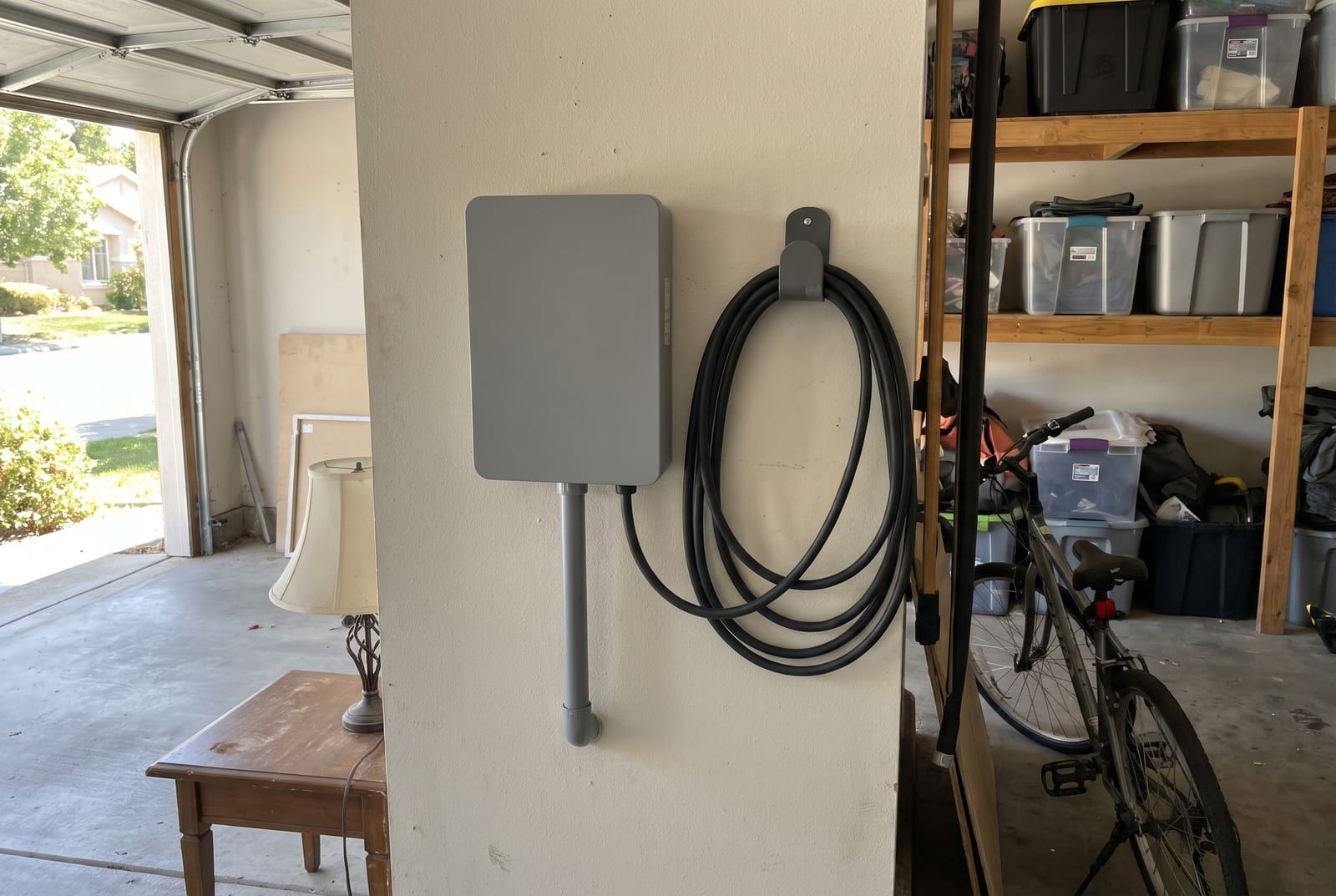
Questions That Shape the Installation
| Question | Why it matters |
|---|---|
| Where will the charger go? | The spot decides the cable length you need, whether the unit must be rated for outdoor use, and how the circuit gets there. |
| How far is it from the panel? | A longer run means more wire, sometimes a heavier gauge to limit voltage drop, and conduit along a garage wall or across a driveway. |
| Does the panel have room? | A Level 2 charger is a large continuous load. The panel needs an open double space and enough capacity, worked out with a load calculation. |
| Outlet or hardwired unit? | A 240-volt outlet lets you unplug and take the charger with you; in a garage it now needs GFCI protection. A hardwired unit avoids the outlet and can charge at higher amperage. |
| What does the car support? | The car’s onboard charger limits how fast it can take power, so a bigger circuit than the car can use adds cost without adding speed. |
Charger Planning Guide
Choose your home, where you park and how old your panel is, and the guide lists the points worth raising when you schedule a visit.
Pick your answers above, then press “Show My Points.”
Charger Questions
Does an EV charger need a permit?
Yes. A new 240-volt circuit for a charger needs an electrical permit from the city or county where the property is, and an inspection afterward. In California, cities streamline permits for home chargers, but the inspection still happens.
Will my panel handle a charger?
Many will, and some won’t without changes. A load calculation adds up the house’s existing loads, including air conditioning, an electric range or dryer, and the charger. If there isn’t room, the options include a lower-amperage charger, a load-management device that pauses charging when the house is busy, or a panel upgrade.
How do I choose a charger?
Pick a unit listed by a recognized testing lab, with a cable long enough to reach the car’s charge port wherever you park, and an outdoor rating if it will be outside. Match its amperage to what your car can accept and what the panel can supply. Bring the model to the visit, or decide on it together after the panel has been looked at.
How fast will a Level 2 charger charge?
That depends on the car and the circuit. A common home setup, a 40-amp circuit feeding a 32-amp charger, adds roughly 25 to 30 miles of range an hour for many cars, which covers an overnight top-up for most daily driving.
Ready for a Charger at Home?
Tell us where you park, your car, and the panel’s age if you know it, and we’ll plan the circuit.